
For many years, developers, property owners, consultants, and councils across New South Wales relied on Capital Investment Value (CIV) when determining planning pathways, assessment thresholds, and development-related fees. While the system was widely used, it was not always straightforward. Different planning instruments referenced different cost definitions, creating uncertainty around how project values should be calculated and assessed.
Recent NSW Planning Changes have addressed that issue by introducing a single, standardised approach known as Estimated Development Cost (EDC).
The move from CIV to EDC represents one of the most significant planning cost reforms in recent years. For anyone preparing a Development Application (DA), understanding what changed - and why it matters - is essential.
Before the reforms, Capital Investment Value was commonly used throughout the NSW planning system to determine whether a project met specific planning thresholds. In simple terms, CIV represented the estimated value of a proposed development.
While the concept appeared straightforward, the practical application often created challenges.
Different planning instruments sometimes referenced different cost measures, and interpretations varied between councils and development types. This inconsistency made it more difficult for applicants to determine which costs should be included and how project values should be reported.
The transition from Capital Investment Value to Estimated Development Cost formed part of broader Planning Reforms NSW designed to improve consistency and transparency across the development assessment process.
These reforms followed recommendations arising from the Independent Commission Against Corruption's (ICAC) Operation Dasha report, which identified concerns around development cost reporting and the potential for inconsistent assessments.
In response, the NSW Government introduced a standardised framework aimed at creating a clearer and more transparent method of assessing development costs. In response, the NSW Government, through the Department of Housing, Infrastructure and Planning, introduced a standardised framework to provide a clearer, more consistent, and transparent method for assessing development costs
Rather than relying on multiple cost definitions, the planning system now uses a single methodology for determining development value.
The result is a more consistent process for applicants, councils, certifiers, and planning authorities.
Estimated Development Cost (EDC) is now the primary cost measure used throughout the NSW planning system. An EDC represents the total cost of carrying out a proposed development and forms the basis of many planning decisions. Unlike some previous methodologies, the EDC framework clearly outlines what should be included when calculating project costs.
This standardised approach has made Development Cost Assessment significantly more transparent than under previous systems.
Although both measures are used to assess development value, there are important differences between the two systems.
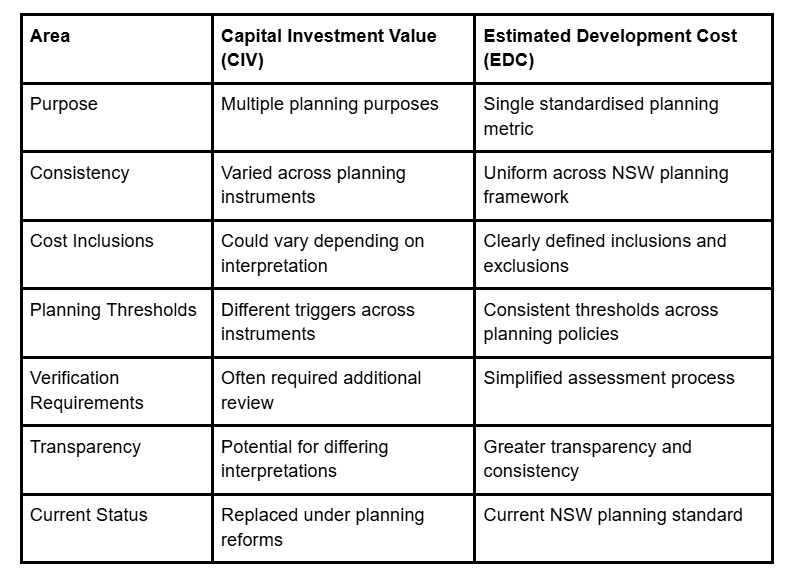
For applicants comparing EDC vs CIV, the biggest change is certainty. The planning system now provides a single framework for assessing project costs rather than relying on multiple valuation approaches.
The shift to EDC affects more than terminology. Because development value influences planning pathways and statutory requirements, an accurate cost assessment remains a critical part of the approval process.
For applicants preparing a Development Application (DA), the reported project value now carries even greater importance because it directly influences how the application will be assessed.
One of the practical outcomes of the reforms is the increased focus on accurate cost reporting. An incorrect DA Cost Estimate can affect multiple aspects of a project, including planning fees, infrastructure contributions, and assessment pathways. Under-reporting costs may lead to delays, requests for additional information, or further review by planning authorities.
Overstating costs can also create unnecessary expenses and affect project feasibility assessments. For this reason, many applicants seek independent cost advice before lodging their applications.
A professionally prepared Development Cost Assessment provides a clear and defensible basis for reporting project value, helping reduce uncertainty throughout the approval process.
Another significant change introduced by the reforms relates to verification requirements. Updated NSW guidance allows councils to accept EDC assessments prepared by appropriately qualified professionals without imposing unnecessary verification processes. The aim is to reduce administrative complexity while maintaining confidence in reported development costs.
This creates a more efficient process for applicants while still ensuring that project values are supported by professional expertise and industry knowledge.
Although the EDC framework simplifies planning requirements, accurately calculating development costs still requires specialised knowledge. A qualified Chartered or Certified Quantity Surveyor (CQS) brings expertise in construction costing, estimating, and project assessment.
This provides planning authorities with a reliable and evidence-based assessment of project costs.
For higher-value developments, independent cost reporting from an experienced CQS often provides greater confidence for both applicants and assessing authorities. For developments with an estimated development cost exceeding $3 million, most local government authorities (LGAs) require the development cost report to be prepared and certified by a full voting member of the Australian Institute of Quantity Surveyors (AIQS) or the Royal Institution of Chartered Surveyors (RICS). This certification requirement also applies to developments classified as State Significant Development (SSD) and State Significant Infrastructure (SSI) .
At Quantum QS, cost planning and construction estimating form a core part of what we do. Our team of experienced Chartered and Certified Quantity Surveyors works across residential, commercial, industrial, mixed-use, strata, education, healthcare, retail, and infrastructure projects throughout New South Wales.
Led by industry professionals with decades of experience in construction costing, valuation, and project advisory services, we provide independent assessments that align with current planning requirements and recognised industry methodologies.
Whether you're preparing a Development Application (DA), reviewing project feasibility, or seeking an independent Development Cost Assessment, accurate reporting remains essential to a smooth planning process.
The move from Capital Investment Value to Estimated Development Cost represents a significant step towards greater transparency and consistency in NSW planning.
By introducing a single standard for reporting development costs, the reforms have simplified assessment pathways, reduced ambiguity, and created a clearer framework for applicants and planning authorities alike. For developers, property owners, and consultants, understanding the difference between EDC vs CIV is important when preparing planning applications and determining project costs.
If you require an independent Development Cost Assessment, assistance with a DA Cost Estimate, or advice on current NSW Planning Changes, Contact Quantum QS to discuss your project with our experienced team of Chartered and Certified Quantity Surveyors.
What replaced Capital Investment Value in NSW?
The NSW planning system now uses Estimated Development Cost (EDC) as the primary measure for assessing development costs, replacing the previous Capital Investment Value framework.
What is included in an EDC calculation?
An EDC generally includes construction costs, demolition, site preparation, associated infrastructure works, and design-related project costs. It excludes land acquisition costs and operational expenses.
Does every Development Application require an EDC?
Requirements vary depending on the project type, value, and local council. Many developments require an EDC assessment as part of the planning application process.
Why are accurate development costs important?
Accurate cost reporting helps determine planning pathways, infrastructure contributions, assessment fees, and eligibility for certain development categories.
Can a Quantity Surveyor prepare a Development Cost Assessment?
A qualified and registered member of the Australian Institute of Quantity Surveyors (AIQS) or the Royal Institution of Chartered Surveyors (RICS) holding Chartered or Certified status is typically engaged to prepare independent development cost assessments. These professionals provide reliable construction cost information to support planning applications and improve the robustness of the submitted proposal. Where a Certified Quantity Surveyor (CQS) is not engaged, the application may be exposed to increased scrutiny and a higher risk of delay, additional information requests, or challenges to the validity of the cost estimate.
Sep 10, 2026
Property valuations are often required when tax, superannuation or transfer obligations depend on an independent assessment of market value.
Aug 31, 2026
When a construction dispute involves disputed costs, variations, delays or final accounts, specialist financial analysis can be critical.
Aug 26, 2026
A pre-construction cost estimate is most valuable during the initial planning and design stage
Aug 18, 2026
A Sinking Fund Plan is essentially a long-term financial forecast built around major capital expenditure and common property maintenance.
